  |
|
The content of this page will help you better care for your puppy once home and provide further information on how to be a suitable dog owner into the adult years with special emphasis on owning this special breed. The information provided here aids you in getting started with recommended books and links to Web sites making it easy to look up valuable information.
Click on link listed below to go straight to topic of interest or simply scroll down page to view all:
Continuing Care Puppy Supply List Book: Bringing Puppy Home Parvo: A Threat to Dobermans Vaccination Schedule Book: New Owner's Guide to Dobermans Comparing Dog Food Brands Nipping at Owner Cats and Dobermans Ear Cropping - Why? and General Guidance Why Dock Tails? Picking a Name for your Puppy Staph Infection Book: How to Raise the Perfect Dog Book: The Genius of Dogs Book: The Doberman Pinscher Intelligence of Dogs [Chapter 12] Other Web Sites with Helpful Info |
|
Continuing Care
Feeding Your New Pup At first it might be necessary to soak your puppy's food in water to soften it. Depending on the age at which you pick up your puppy, you should only have to do this for a week. It is rare by 8 weeks old for a puppy to be unable to eat dry food. This is a precautionary recommendation. Nonetheless, if your pup needs it soaked initially after going to its new home, try your puppy with food that has not been softened with water after a week or so. If the puppy has no trouble eating the food hard, you may stop soaking the food prior to serving. Your puppy has been getting fed twice a day - once in the morning and once in the evening. Always be sure to supply your puppy with adequate water. Just as drinking plenty of water is good for you, it is also good for your puppy on into adulthood. DO NOT limit water to avoid potty accidents. Since 4 weeks of age, your puppy has been fed Diamond Naturals Dry Food for Puppy, Large Breed Lamb and Rice Formula, 40 Pound Bag. We chose this food brand because it was rated well on DogFoodAdvisor.com. Grooming One of the nice things about Dobermans is their hair length. You will not need to get it cut. You will, however, need to brush the coat on a regular basis. This will help remove loose hairs and stimulate the oil glands to produce a healthy coat. We recommend using what is called a shedding blade for you to brush with. Here is a link to one on Amazaon: SAFARI Dual-Sided Shedding Blade, One Size, Dog Shedding Brush, Deshedding Tool for Dogs, Dog Hair Remover, Dog Grooming, Dog Brushes for Shedding, Stainless Steel  Nail trimming: The puppy has been getting its nails clipped almost weekly. We do it this often to help out mom as their tiny nails get sharp and that wreaks havoc on mom while they nurse. For continued care as pups get bigger and later into adulthood, it is necessary to clip nails every 3 to 4 weeks. Try not to let them get too long. It can cause problems with walking and be an uncomfortable nuisance. If too long, there is a risk of the nail splitting or breaking which is terribly uncomfortable for your Dobe. If you forget and the nails do get too long, the quick in the nail will extend out as the nail extends in length. The quick is the live tissue within the nail. If clipped, it will bleed. Do not worry too much if you clip the quick and cause bleeding. It is not that painful - but it will be quite messy. To "chase" the quick back and get the nail back to a normal length, you will need to clip the nails every 3 to 4 days - just a little bit at a time, thin slivers. It will take some time and effort, but it will be well appreciated in the long run. Nail clippers on Amazon: Best Professional Pet Nail Clipper Large  And ... you might want to consider having Styptic powder on hand for those times you do trim the nail too close. This is handy to stop the bleeding fast: Remedy and Recovery Professional Groomer's Styptic Powder for Pets, 1.5-Ounce And ... you might want to consider having Styptic powder on hand for those times you do trim the nail too close. This is handy to stop the bleeding fast: Remedy and Recovery Professional Groomer's Styptic Powder for Pets, 1.5-Ounce Chewing Expect your puppy to be a chewer for about the first year of life. The puppy has some big teeth coming in and to sooth its gums, the puppy is going to resort to chewing. Buy chew toys and LOTS of them! And, keep shoes and other objects you do not want to get chewed up off the floor. These pups are extremely smart, but there will be a physical need for them to chew. To keep everyone happy, try not to set the puppy up for failure. Keep the puppy’s toys on the floor and everything else up. Do not choose toys that are small in relation to your pups mouth size. Surgical removal of swallowed toys is a real thing. Additionally, do not choose toys with pieces that may be easily chewed off and swallowed. Lastly, DO NOT by raw hides of any shape or form. These are choking hazards and no dog should be given one. Whining There is a real chance when you bring home your new puppy, he is going to whine the first few nights. This is separation anxiety. The puppy is used to being with mom plus a lot of littermates. To help, you can try putting a ticking clock in the crate or area that pup is sleeping (simulates a heart beating). You may also try putting pup in a laundry basket with a towel (preferably one we send home with you), place that beside your bed and sleep with your hand in the basket. Not ideal, but when you are desperate in the wee morning hours, you will be ready to try anything. This should not last more than a week. Your new pup will require some adjustment time. Prepare yourself mentally for that before bringing pup home. In preparation for the upcoming weeks where you will likely get limited good sleep, we recommend concentrating on getting plenty of sleep before you bring puppy home. If you are blessed with a pup that doesn't experience separation anxiety, odds of being woke up in the middle of the night are still reality because you have entered the potty training stage. Shots At 6 weeks old, your puppy will receive his first series of shots. The next set of shots will be administered at 8 weeks old. Since the pups go home around 8 to 10 weeks of age, it is then your job to make sure your pup receives the next rounds at 12 weeks, 16 weeks, and 20 weeks. Get with your vet for further information noting we highly recommend an additional parvo booster for this breed as Dobermans are more susceptible to parvo than other breeds. Mention and discuss this with your vet. |
|
Supplies Your New Puppy Will Need
1. Pet food. To get your new puppy off to a good start choose a puppy formula for large breed. We recommend Diamond Naturals Dry Food for Puppy, Large Breed Lamb and Rice Formula. Diamond Naturals Dry Food for Puppy, Large Breed Lamb and Rice Formula, 40 Pound Bag 2. Food and water bowls. Dobermans are surprisingly messy drinkers. Here is a feeder/bowl set up to we found to help contain the mess: Neater Feeder Deluxe Large Dog (Bronze) - The Mess Proof Elevated Bowls No Slip Non Tip Double Diner Stainless Steel Food Dish with Stand  3. Identification tag. While it can be fun to get the tag from the engraving machine at the pet store, it's expensive and lines of text allowed on the tag is limited. Here is a cheap option from Amazon that allows up to 8 lines: Pet ID Tags - 8 Lines of Engraving Available | Size Small or Large | Bone, Round, Star, Heart, Hydrant, Paw, Cat Face | 9 Colors | Dog Tag, Cat Tag, Personalized, Anodized Aluminum  4. Collar and leash. Dobermans grow really fast over the first year of life then start filling out their large frame the second into third year of life. Keep this in mind when purchasing your collar as you will find you need to buy new ones as your pup grows. 5. Travel crate to accommodate your puppy's adult size. We do not crate our Dobermans. That being said, we are not against crating just do not crate for excessive amounts of time. The decision to crate should be a safe place for your Doberman while you step away from your home and never for punishment or extended periods of time. 6. Stain remover for accidents and spills. One of our favorite cleaners for cleaning up: Nature’s Miracle Stain and Odor Remover Dog, Odor Control Formula  7. Shedding blade. This tool is handy for getting grass off the coat in addition to loose hairs (note Dobermans do not shed bad, but there are loose hairs especially when weather starts warming up). Our Dobermans love to roll and wriggle on their backs in the yard. When the grass is dead, they will collect quite a mess of grass on their backs. This tool is a lifesaver to get grass off before coming back inside. SAFARI Dual-Sided Shedding Blade, One Size, Dog Shedding Brush, Deshedding Tool for Dogs, Dog Hair Remover, Dog Grooming, Dog Brushes for Shedding, Stainless Steel 8. Dog shampoo. There are truly lots of good options, but here is a favorite of ours: Nature’s Miracle Natural Oatmeal Shampoo And Conditioner For Dogs, Honey Sage Scent 32 Ounces  9. Safe chew toys to ease teething. Not going to make a specific recommendation here other than to choose wisely. Do not choose toys that are small in relation to your pups mouth size. Surgical removal of swallowed toys is a real thing. Additionally, do not choose toys with pieces that may be easily chewed off and swallowed. Provide LOTS of acceptable chewing options as your pup goes through the chewing stage especially while losing baby teeth. It is not hard to train a pup not to chew on furniture, shoes, and other unacceptable human items provided you make acceptable options available and plenty of them lying around. Lastly, DO NOT by raw hides of any shape or form. These are choking hazards and no dog should be given one. Here is link to an example of raw hides. Again, DO NOT buy. The link provided for educational purpose: Pet Magasin Natural Rawhide Chips – Premium LONG-LASTING Dog Treats with Thick Cut Beef Hides, Processed Without Additives or Chemicals  10. Flea, tick and parasite controls. Choose based off your veterinarian's recommendations. 11. Nail clippers. If you choose to trim your Dobermans nails yourself, here is the style we recommend: Best Professional Pet Nail Clipper Large
|
|
Bringing Home Your New Puppy
Your new puppy will need time to adjust to its new home. The environment will be different and the pup will be missing mom and its littermates. Being surrounded by new faces and voices will be strange for your pup. It will all be a little overwhelming. To help your pup adjust with minimal stress, make sure you allow your new pup quiet time to rest. White noise (fan, static on a radio, etc.) is actually soothing. When you or your pup are ready for some down time, try crating your puppy in a bathroom or other room with no windows that may easily be made dark, turn on the vent fan or provide some other source of white noise. Be sure to close the door to the room to minimize any sounds you or your other human occupants make inside the house. We will send each pup home with a towel that was used during their initial upbringing with us. Don't expect a perfectly brand new towel! It will be freshly washed, but the point here is to send home with the pup an item that has the scents from our dwelling to yours. You may want to bring a blanket with you at time of pick up. We can then rub it on mom and the litter mates to get their scent on it. Keep the towel and/or blanket with your new pup as it will provide some comfort as he adjusts to his new home. Here is a recommended book to help you get off to a great start with your puppy. |
|
Parvo: A Threat to Dobermans
According to a study published in the "Journal of the American Veterinary Medical Association," Rottweilers, Doberman Pinschers and German shepherds have an increased risk of developing parvo while toy poodles and cocker spaniels have a decreased risk. We recommend a 4th round of the parvo vaccination for extra coverage to protect Doberman puppies from contracting parvo. A good veterinarian will help guide you through this confusing year of caring for your young pup. Additionally, we recommend that you do not expose your pup to any environment where the potential for exposure to harmful pathogens might be high. For example, as much fun as taking your pup to the dog park or even the pet store might sound, we highly advise against it until your pup has completed its full vaccinations. This is extremely important with this particular breed given that Dobermans are more susceptible to Parvo. |
|
Vaccination Schedule
[From: The Humane Society] Types of Vaccinations: Distemper - An airborne viral disease of the lungs, intestines and brain. Hepatitis - A viral disease of the liver. Leptospirosis - A bacterial disease of the urinary system. Parainfluenza - Infectious bronchitis. Parvovirus - A viral disease of the intestines. Rabies - A viral disease fatal to humans and other animals. Corona - A viral disease of the intestines. Bordetella - A bacterial infection (kennel cough). Schedule for Pups -- 6 weeks to 1 year 6 to 8 weeks - First puppy shot (DHPP) + Corona [DHPP = distemper, hepatitis, parainfluenza, and parvovirus] 11 to 12 weeks - Second puppy shot (DHLPP) + Corona [DHLPP = distemper, hepatitis, parainfluenza, leptospirosis and parvovirus] 15 to 16 weeks - Third puppy shot (DHLPP) + Corona Over 4 months - Rabies (repeat l year later) 7 to 9 months - First heartworm test Schedule for Adult Dogs -- After 1 year old DHLPP - Yearly Heartworm test - Yearly Rabies - Every 3 years (after second Rabies shot) Bordetella - Yearly For further reading, here's an short informative article: WHAT SHOTS ARE REQUIRED FOR DOGS?
NOTE: Garretts Dobermans highly recommends an additional parvo vaccination to what is listed above which only has 3 doses within the pup's first year. Dobermans are more susceptible. Consult with your vet.
|
|
New Owner's Guide to Dobermans
Here is an oldie but goodie so it might not be available through the link provided below. But, if you can get your hands on a copy, it's a great book for people new to the Doberman. It gives an overview of the breed's history, temperament, care and training requirements. It touches on the different activities you can participate in with your Doberman and lists addresses to contact for more info. The health care chapter briefly explains all the major diseases and parasites that you must have your dog vaccinated against. For more in depth training methods for the novice, however, it is best to consult a specific manual on the subject or sign up for some initial obedience training classes which is a fun way to spend time with your new Doberman with useful applications at home. |
|
How does your Dog Food Brand compare?
The Dog Food Advisor is a public service website designed to help you make a more informed decision when buying dog food. Free guide to choosing the best large breed puppy foods: (you may also sign up to receive email alerts on dog food recalls) |
|
Nipping at Owner
May 5, 2002 - "One question I have: The pup started nipping at us even in the truck on our way home from the airport. She does it to everyone and a lot. I thought (hoped) it was due to her thinking we were her new 'littermates' and that's how she acted with them. "We hold her mouth closed tight for 2 seconds then release and give her a toy to chew or pet her again. Does this sound OK? It's not chewing as much as nipping, so I need to 'nip' it in the bud." "We are doing the touching, etc. etc. . you talk about on your Web site. She seems to tell already from the tone of my voice when she needs to stop something, I don't say 'no' a lot. I either substitute the behavior with the right thing to do, or I look her in the eyes with a firm voice and she seems to get it. Any advice?" Thanks, Kathy ANSWER: I simply told Kathy that what she is doing is perfect. What you have to keep in mind is the age - 7 weeks. At this age, all the pups seemed to like to chew on hands, toes, nip at skin, each other... This has to be corrected and the method Kathy is using is great. You absolutely must not allow the chewing on your body parts, though. Definitely not good behavior. As the pup gets older, the tendency to chew will decrease. By 12 weeks of age, there is a big difference in the desire to chew opposed to 7 weeks of age. 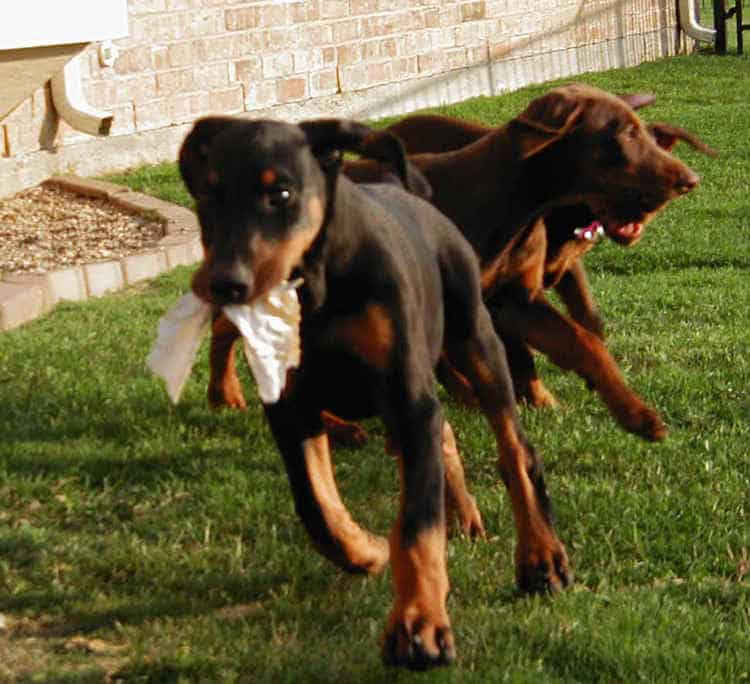 |
|
Cats and Dobes
"Good afternoon Laura. How have your dobbys been around cats. Is there any way we can condition the pups (Trinity) to cats earlier. Is there any cats in your neighborhood that you could introduce her to?" --- Thanks, Tara M. ANSWER: Don't worry about the pup with cats. If she is brought up with them, there isn't going to be a problem. She will play with them (if they let her!) and will probably become protective of them. They will become family. My mother has 3 Dobermans and 3 Yorkies -- the small ones. The Dobes are great with them. Just the other day I was speaking to one of the owners from Aggie's first litter (Natasha's owner, Leslie). She told me a funny story about their Dobe who has never been around cats. She said they went out of town and had some friends "babysit". The friends had a cat. Apparently, the Dobe and the cat fell in love with each other -- they would just sit and lick each other!! |
|
Ear Posting Guide for Cropped Ears -- YouTube Video by Garretts
If you are going to crop the ears -- and we think you should!! -- here is a YouTube video that provides a step-by-step guide on how to wrap the ears: Here is a link to an interesting discussion regarding reasons to crop the ears. We believe it is better for the health of the ears. To read short article, click here. If you wonder why ears ever started being cropped in the first place, then click on the link below for an explanation: Link to Explanation Doberman ear cropping information with the different ear lengths shown. >>Click Here -- Dobermanclub.org Many people have questions about various aspects of ear cropping, and we hope this information will help. It explains the decisions you will need to make before your pet's upcoming surgery, and gives you some information about our practice in general. >>Click Here -- to read FAQs |
|
Why Dock Tails?
"Hi Laura, I was wondering - Why do dogs have their tails docked? I know it is a breed standard but why? I know I am like your four year old but I was curious." Tara F. ANSWER: As I had to explain to my 7 year old who can understand - there is just not any making my 4 year old understand truly other than "the vet just needed to take it off". Anyway, it is definitely a breed standard and I just don't like the way a long tail looks on a big dog. But, I am pretty sure that the tails started being taken off for two other reasons - 1) danger to itself as it would wack things and injure its tail and 2) it wacks you! If you have ever been around a large dog from another breed that keeps the tail, you would understand how nice it is to not have it there. Imagine something about the size of a young kid's arm swinging back and forth pretty much uncontrolled with no regard as to what it might swing into! |
|
Picking a Name
Picking a name can be hard. Here are a couple of links that provide a list of names - hopefully making this task a little easier on you! Puppy Names for Dobermans 2,000 Dog Names Great Puppy Names If you prefer a hard copy and more extensive list, try out these books: When Rover Just Won't Do: Over 2,000 Suggestions for Naming Your Puppy  5,000 PERFECT PUPPY NAMES: HOW TO CHOOSE JUST THE RIGHT PUPPY NAME 
|
|
Staph Infection
June 12, 2012 - "Hello, My husband and I recently bought a Blue Doberman pup named Samson and he is almost 5 months old (born January 27th). He started getting bumps on his back and is now starting to lose his hair in little patches. One of the spots had pus in it and looks like it is healing, but his hair is not growing back. We feel a few more bumps in other areas of his body as well. It has been about a week since he lost some hair. We are not sure if it genetic, since he is a Blue, or possibly staph? If it is staph is it contagious to other animals or humans? Other than the skin problem, he seems to be healthy. He still has tons of energy and keeps us on our toes :) Any information will be of help! Thank You, Franc and Ashley" ANSWER: Sorry to hear you are having some problems. My gut feeling is that it is staph. I looked up info for you to read below. Also, I looked up a shampoo that should help. Here is link to amazon (called DermaPet): >> Click Here to purchase on Amazon I would suggest giving the shampoo a try. If it is a bad case of staph, he may need an antibiotic which means a trip to the vet. The vet can then also determine if it is something else. Keep me posted! Information below copied off : http://www.vetinfo.com/diagnosing-staph-infection-dogs.html#b
Treating Canine Staph Infection
Your vet will recommend shaving any hair in the affected area before you apply any ointments for the treatment of staph infection in dogs. Ointments can help relieve the symptoms of staph skin infection. Your vet will prescribe oral antibiotics for the treatment of the infection itself. While your dog is undergoing treatment for staph skin infection, keep him clean by bathing him regularly with an antibiotic dog shampoo, such as one that contains benzoyl peroxide. Oozing wounds, scratches and blisters should be kept bandaged during the recovery process. Keep your dog's bed and living areas clean and disinfected. Veterinarians don't think that staph infections of the skin are highly contagious to other animals or humans, but it's a good idea to limit your dog's contact with other animals while he recovers from staph infections. Wash your hands and change clothes before and after handling your sick dog. Remember, even if you're not vulnerable to infection with staph bacteria, your dog could develop secondary infections if he comes into contact with other bacteria found on your clothes or hands. |
|
How to Raise the Perfect Dog
A puppy’s brain is like a sponge—soaking up all the smells and sights and experiences in the world as fast as it can. A well-stimulated pup will grow up to have a larger brain with more cells, bigger cells, and more interconnections between them. Hearing loud noises, getting regular exercise, meeting new dogs and people, traveling to new places, and even going through agility course training for a few minutes each day make for a stronger brain. We can influence the development of a puppy’s brain by providing him with the best environment possible when he is a newborn pup. Likewise, a dog that is deprived of stimulation or that doesn’t have interactions with other dogs or humans is more likely to have a smaller brain and be less balanced. I have seen many situations in which an under stimulated dog is not only an unhappy dog but also a dull, almost lifeless animal. Keeping your dogs mentally challenged and constantly exposing them to new things are just as important as taking them for walks and exercising them. Bored dogs develop destructive behaviors and take their negative energy out on things like your furniture. Quick link to order book:  
|
|
The Genius of Dogs
This dog genius revolution is transforming how we live and work with our canine friends, including how we train them. Does your dog feel guilt? Is she pretending she can't hear you? Does she want affection—or just your sandwich? In The Genius of Dogs, Brian Hare and Vanessa Woods lay out what discoveries at the Duke Canine Cognition Lab and other research facilities around the world are revealing about how your dog thinks and how we humans can have even deeper relationships with our best four-legged friends.  
|
|
The Doberman Pinscher
The Doberman Pincher has an enthusiastic following worldwide. This book examines what makes the breed so special, with information on care, health, showing, the top dogs and more for seasoned fanciers and novices alike. The authors emphasize humane, sensitive dog care, and encourage owners to make the most of the Doberman's intelligence and trainability.  
|
|
Chapter 12 of The Intelligence of Dogs: Canine Consciousness and Capabilities by Stanley Coren
Increasing a Dog’s Intelligence (Chapter 12 of The Intelligence of Dogs – Canine Consciousness and Capabilities by Stanley Coren) As in the case of humans, the intelligence of dogs is not fixed but can be influenced by rearing and life history. Each of the four principal dimensions that affect manifest intelligence – i.e., instinctive intelligence, adaptive intelligence, obedience and working intelligence, and the personality factor – can be improved. Most of the techniques that will be mentioned in this chapter work best with your dogs (although even adolescent and young adult dogs will respond to a number of them), and many should be started as soon as the dog moves in. Improving Personality Two aspects of personality play an important role in a dog’s obedience and working intelligence. The first is the dog’s orientation to humans, which includes its paying attention to what a human is doing and its seeking social affiliation with people. The second is the willingness of the dog to accept human leadership, rather than fighting for dominance and control. To shape your dog’s personality, it is best to begin with a young puppy. By exposing your new puppy to appropriate experiences at various critical periods in its life, you can actually mold its character into one that will support later working and obedience ability. For the average dog owner, the most critical period is between seven and twelve weeks of age. A puppy should remain with its littermates for around seven weeks. During this period, it develops its identity as a dog, learns to recognize dogs as social objects, and masters the basic behaviors needed to interact with other dogs. Social contact during this period is important, and it may need to be increased artificially if the litter is small (say one or two). This means that other (nonaggressive) dogs should be introduced to the puppies to increase their social contact with other dogs and to counteract the relative social isolation of a small litter. If no access to other dogs is possible, there is some evidence that human contact, in the form of one or two daily ten-minute episodes of play, touching, talking, and rubbing will help. The optimal time to remove a dog from its litter and place it in its home is at seven weeks. Over the next five weeks, if the dog is given a lot of exposure and interaction with humans, it will come to accept human beings as members of its pack. It is this acceptance that allows dogs to interact well with people. Puppies that do not receive enough human contact and interaction during this period grow up to be difficult dogs. They do not attend to their masters’ commands and often turn out to be quite unsuccessful as working and obedience dogs. Exposing the dog to the people with whom it will ultimately live produces the best and strongest social bonds. If this is not possible, daily play contact with any humans will work at least to establish the importance of humans in the dog’s psyche. The positive feelings developed can then usually be transferred successfully to a new master. After puppyhood, there are still practical ways to improve dogs’ personality characteristics. Even dogs that are naturally dominant can come to accept the leadership and control of humans happily and consistently. Age, however, is still an important factor, and the steps that need to be taken should be started when the dog is as young as possible. Furthermore, the exercises involved should be repeated, at least occasionally throughout the dog’s life. They form the basis of a behavior modification program that can give you a dog with the most desirable set of personality characteristics. Touching This touching is not the simple stroking or fondling that we do to please the dog or ourselves but rather a systematic touching of the dog’s whole body. It mimics the pattern of licking and touching that a mother dog applies to her puppies, which helps to establish an emotional bond but is also an expression of her dominance and control of the litter. The significance of being touched carries over into adulthood: among wild dogs and wolves, a dominant member of the pack, such as the leader, can nuzzle, sniff, or touch any of the lower-status pack members at its pleasure. By allowing this treatment, the other pack members signal their acceptance of the dominant dog’s leadership. Just as with the mother dog and her puppies, however, the touching also establishes a positive emotional bond between the one touching and the one being touched. You should be sure to touch your dog systematically on an almost daily basis, and everyone in the family, especially the children, should be taught the ritual. The procedure to follow is quite straightforward. While talking in a soothing manner, saying the dog’s name frequently, have it sit or stand in front of you. ……… The entire touching routine takes only about thirty seconds to a minute, and your dog will probably enjoy all the attention. One additional benefit of this touching procedure is that touching your dog thoroughly on a regular basis will teach you the feel of its body, and you will immediately notice any unusual lumps or tender areas. An alternative to touching is grooming, which involves the same kind of systematic touching. Grooming is a more vigorous form of touching that makes the dominance of the groomer more obvious. It has the side benefits of making the dog look better and keeping the house freer of hair if you have a breed that sheds. Just remember to talk to the dog throughout the grooming process, using its name frequently. Manipulation and restraint To establish your dominance and leadership more firmly, you should deliberately manipulate and restrain your dog on a regular basis, placing it in the position that, for wild canids, signifies submission to the authority of a dominant member of the pack. If your dog is already an adult, you may need a firmer hand. All that is necessary is periodically to restrain the dog in some way for a minute or two. Speaking gently to the dog, hold its muzzle closed for a few seconds. Then push the dog over on its side, and hold it there for the better part of a minute. If the dog doesn’t elevate its legs when you do this, lift its legs into a more submissive position, or roll the dog on its back so that its legs are pointed up. Look directly at the dog’s eyes as you do this. When the dog turns its head away, you can end the exercise and fuss lightly with it to get its tail wagging. (Dominant dogs stare down lower-status dogs with a fixed gaze, and the lower-ranked dogs indicate their acceptance of the authority so demonstrated by looking away.) On occasion, you should pull the dog gently toward you by the scruff of its neck or the skin at the side of its neck. If the dog is small you can simply lift it up for fifteen or twenty seconds. These simple actions mimic the way a female dog manipulates and controls her young puppies. Enforcing the pack hierarchy There are certain behaviors that characterize the leader of the pack and his followers. The leader gets first choice at any food, can sleep anywhere it likes, goes first through any opening or into any new territory, and can demand attention any time it wants it. If your dog accepts you (and your family) as the pack leader, it will be a happy, albeit lower-ranked, pack member that is much more willing to accept commands and controls. You must reinforce your leadership by exerting the prerogatives of the pack leader. As the pack leader, you should never let the dog rush out of a door or through a gate ahead of you. When the dog is resting in a favorite spot, you should make it move from time to time. (I simply say, “Excuse me,” and shoo the dog a few steps away. After a while, “Excuse me” comes to mean “move” to the dog.) The moment the dog has complied willingly, praise it, and let it return to its original position if it wants. You should also occasionally take an object or some food away from the dog. (It is best to start doing this when the dog is still a puppy, when aggression is less likely and more easily controlled.) The moment you have done so, praise the dog for being nonaggressive and return the object or give the dog an additional bit of food. Finally, the dog should not be allowed to demand attention capriciously by pawing, barking, or placing its forepaws on you. If the dog does this, you should silently restrain it by rolling it on its back or side and staring momentarily into it eyes. Attention and compliance exercises The preceding exercises are designed to modify a dog’s dominance behaviors. Another set seeks to shape the dog’s attention to humans and its acceptance of human control. The first aspect of gaining control over a dog is to have it learn its name. This is why you should repeat the dog’s name over and over when you perform the exercises described above. Indeed, whenever you stroke the dog, feed it, greet it, or have any interaction with it at all, you should start with the dog’s name. By doing this regularly, the name comes to mean, in the dog’s mind, Something is about to happen that concerns me. Thus, the dog will soon come to look at you whenever its name is spoken. Perhaps the most important single command to teach the dog is sit. It causes the dog voluntarily to cease any other activities and places it in a position that can conveniently serve as a starting point for other activities. Teaching a puppy this command is also very rewarding because the dog learns it almost automatically. Simply wave a bit of food once or twice in front of the dog, and then say the dog’s name followed by the word sit. As you do this, hold the hand with the bit of food in it above but just behind the puppy’s head. Most dogs will naturally sit under these conditions because that posture allows them to keep watching the hand. If the puppy does not sit, gently fold its hind legs under its hindquarters to place it into position. Either way, when the dog sits, give it the bit of food and some praise. Next, with no food in your hand, repeat the sequence of saying the dog’s name and the word sit and placing your hand above and slightly behind the puppy’s head. When the dog sits, again give it a bit of food and some praise. After ten or so repetitions, when the dog is reliably sitting with the verbal command and the gesture, you can probably drop the hand signal, and the dog should begin sitting to the verbal command alone. Once the sit command is established, it can be used to start instilling in the dog the habit of obeying other commands. To do this, you should never give the dog anything for free. Before you feed the dog, make it sit; before you pet it, make it sit; before the dog gets to go out the door, make it sit; and so on. Later on, when the dog knows commands other than sit, you can alternate among the commands that you require the dog to obey before it gets what it wants. What the dog is really learning in these situations is that it must first respond to you, its leader, and that when it does so, it gets things it wants. The dog must feel that you are always in control of it. This means that you should never ask the dog to do something unless you are sure that it will actually perform the required action. Obviously, a trained dog will generally comply with your commands, but until you reach that stage, you or someone else should be in a position to enforce the command. For instance, you should not tell the dog down unless you are close enough physically to place the dog in a lying position. Similarly, until the dog responds reliably, you should not cal it unless it is on leash. This allows you to reel it in like a fish if it fails to respond promptly. The idea is to impress on the dog that your commands to it are not requests, or pleas, or the beginning of a negotiation, but rather instructions that must be complied with because they will be enforced. At the same time, whenever the dog does comply (even if you have to compel it to do so), it should be praised or otherwise rewarded. This way, the dog comes to associate working for you with pleasant outcomes. Remember that you should never let the dog get into situations where it is highly likely to misbehave or disobey you. Once you have taught the dog some basic commands, or even some parlor tricks, these should be practiced on a regular, but unpredictable, basis. While walking the dog, make it come to you and sit down. While watching television, make the dog sit or lie down. This random repetition is important, not simply as practice for the commands but also as reinforcement for the idea that the dog must pay attention to you and follow instructions without question. That concludes the pertinent information in the book helping you establish your relationship with your Doberman. Hopefully you found the information useful. Finding a copy of this book is not easy. Here is a link to Amazon. Occasionally old copies become available.
 
|
|
Dog Owner's Guide
More than 300 pages of features, breed profiles, training tips, health information, and articles about shelters, rescue, dogs and the law, and just about everything else you need to know about living with your dog. You will find articles to help you choose a breed, a breeder, and a puppy; how to teach that puppy good manners, how to choose a veterinarian, a boarding kennel, a groomer, or a trainer, what to expect at a dog show, and much, much more!
|
|
Life with a Doberman Pinscher
"The Doberman Pinscher is a faithful companion with high intelligence and alertness. They are commonly associated with military, police, and personal defense uses, although Doberman Pinschers also enjoy a loyal following with dog enthusiasts around the world. Modern breeders have worked to curb the aggressiveness and ferociousness of the breed to enhance their abilities as companion animals, but Doberman Pinschers in general retain some of these characteristics. They respect and protect their owners and territory, but Doberman Pinschers still make good family pets with the proper training and early socialization." Just about everything you want to know about Dobermans is made available in a very user friendly format: |
|
Pet Place
Contains helpful information for a variety of pet types. The page we've linked to is titled, "Selecting a Dog Breed", but there is so much good information beyond breed types within this page. A very useful site to have access to with a variety topics.
|
|
The Pet Med Library by Mar Vista Animal Medical Center
Lots of useful information archived within the library of this site. Great tool for educating yourself. Informational materials on some of the most common medical concerns of pet dogs & cats adapted to the World Wide Web so that the entire global community may benefit. Topics are arranged alphabetically. Information on a wide variety of veterinary drugs can be found in The Pharmacy Center.
|
|
The Vet's Library
This digital library has been put together as an educational resource for vets and vet techs. If you are the type of person that likes more technical information, then you will find this interesting and possibly helpful.
|
|
All Content Copyright © 2000-present GarrettsDobermans.com. All rights reserved. |